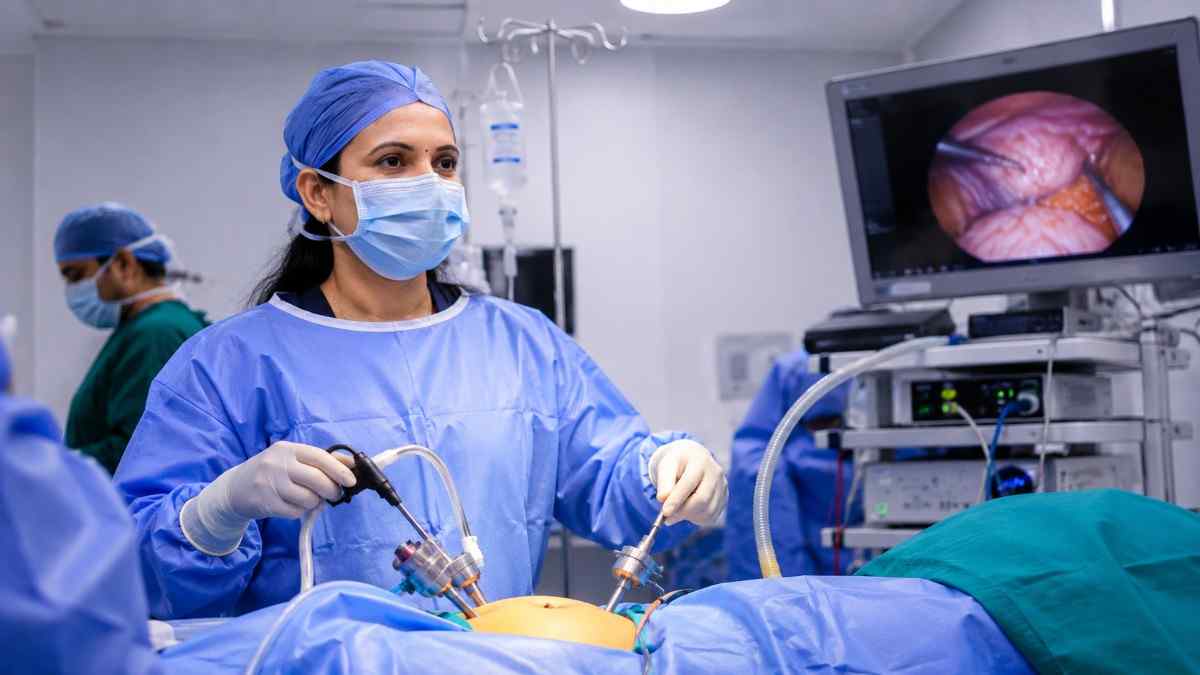
The good news is that this category of surgery has changed dramatically over the last two decades. Smaller incisions. Faster recovery. Significantly better outcomes. And with the right surgeon, the entire experience is far less frightening than most women expect.
This guide is here to walk you through everything: what the procedures involve, who actually needs them, how to prepare, what recovery looks like, and how to find a surgeon in India you can genuinely trust.
What Is Female Reproductive Endoscopy Surgery?
At its core, female reproductive endoscopy surgery in India refers to a group of minimally invasive procedures where a surgeon uses a thin, camera-equipped instrument to visualise, diagnose, and treat conditions inside the female reproductive system.
No large cuts. No prolonged hospital stays. Just precision work through small access points, guided by a live camera feed.
There are two primary procedures under this umbrella:
Laparoscopy uses a slim camera inserted through a tiny incision near the navel to examine and operate on the uterus, ovaries, fallopian tubes, and surrounding pelvic structures. It is the gold standard for diagnosing and treating endometriosis, removing ovarian cysts, managing ectopic pregnancies, and investigating chronic pelvic pain.
Hysteroscopy involves passing a narrow telescope-like instrument through the cervix into the uterine cavity without any external incision at all. It is used to remove uterine polyps, fibroids growing inside the uterus, correct structural abnormalities, and investigate causes of abnormal bleeding or recurrent pregnancy loss.
Both are performed under anaesthesia and are routinely available at well-equipped gynaecological centres across India.
Why India Has Become a Significant Destination for Reproductive Endoscopy
When I first started researching how women from smaller cities and even from abroad were navigating surgical care for reproductive conditions, one pattern was clear. India's combination of trained laparoscopic surgeons, modern hospital infrastructure, and significantly shorter wait times compared to many countries has made it a genuinely strong option.
According to a report published by the National Health Systems Resource Centre, minimally invasive gynaecological surgeries in India have grown by over 40% in the past decade, driven largely by trained laparoscopic specialists and better awareness among women about their treatment options.
That growth is not just a statistic. It reflects real women choosing informed, less-invasive pathways over the open surgeries that were standard practice a generation ago.
In my experience, women who take the time to understand their procedure before walking into the operating theatre recover both physically and emotionally far more smoothly than those who go in without preparation. Knowledge genuinely reduces anxiety.
Common Conditions Treated Through Female Reproductive Endoscopy Surgery in India
This is where most guides get vague. Let us be specific. Here are the conditions most commonly addressed through endoscopic reproductive surgery:
- Endometriosis — tissue similar to the uterine lining grows outside the uterus, causing severe pain, inflammation, and fertility problems. Laparoscopy is the only definitive way to diagnose and surgically treat it.
- Ovarian cysts — persistent or complex cysts that do not resolve with medication are removed via laparoscopic cystectomy, preserving as much healthy ovarian tissue as possible.
- Uterine fibroids — fibroids growing inside the uterine cavity (submucosal) are removed hysteroscopically. Larger external fibroids may require laparoscopic myomectomy.
- Uterine polyps — small growths on the uterine lining that cause abnormal bleeding or implantation failure in IVF are removed through hysteroscopy.
- Ectopic pregnancy — a pregnancy developing in the fallopian tube is a surgical emergency managed laparoscopically to preserve the tube wherever possible.
- Pelvic adhesions — scar tissue from previous infections or surgeries that cause pain and fertility problems is released laparoscopically.
- Uterine septum — a structural abnormality inside the uterus linked to recurrent miscarriage is corrected via hysteroscopic metroplasty.
- Chronic pelvic pain — when imaging does not provide a clear answer, diagnostic laparoscopy is often the next step to identify the source.
Each of these conditions has a direct impact on quality of life. The fact that they can now be addressed without large incisions or lengthy hospitalisation is genuinely significant.
The Difference Between Diagnostic and Operative Endoscopy
This distinction matters and most patients are never clearly told about it.
Diagnostic endoscopy is performed purely to look. The surgeon examines the pelvic or uterine structures to identify what is causing symptoms. No treatment is carried out during the same procedure. This is common when imaging has been inconclusive and the clinical picture is unclear.
Operative endoscopy goes a step further. The surgeon both examines and treats during the same session. Cysts are removed. Adhesions are released. Polyps are excised. This is more common now because surgeons with sufficient laparoscopic experience prefer to address what they find in real time rather than bringing the patient back for a second procedure.
When you speak to any surgeon about female reproductive endoscopy surgery in India, one of the first questions you should ask is whether they plan a purely diagnostic approach or whether they will proceed operatively if they find something during the same session. The answer tells you a great deal about their experience level.
What to Expect Before, During, and After the Surgery
Before the Procedure
Your surgeon will order pre-operative investigations including blood work, a pelvic ultrasound, an ECG if you are over 35, and sometimes an MRI for complex cases. You will be asked to fast for a minimum of six to eight hours before the procedure.
I have noticed that patients who prepare a detailed written summary of their symptoms, previous treatments, and specific concerns before their pre-operative consultation get significantly more out of that appointment. Do not leave it all to memory.
During the Procedure
Laparoscopy typically takes between 30 minutes and 2 hours depending on what is being done. Hysteroscopy is usually shorter, often under an hour for straightforward cases. Both are performed under general or regional anaesthesia. You will not feel anything.
After the Procedure
Recovery for laparoscopy typically involves one to three days of rest and a return to normal activities within a week to ten days for most women. Hysteroscopy recovery is even faster for many patients, often just one to two days.
Expect some bloating, shoulder tip pain from the gas used during laparoscopy, and light spotting after hysteroscopy. These are normal and resolve quickly.
Follow-up is not optional. Your surgeon will want to review your recovery, discuss operative findings, and plan any ongoing treatment. Missing follow-up appointments is one of the most common and avoidable mistakes women make after reproductive surgery.
How to Choose the Right Surgeon for Reproductive Endoscopy in India
The skill gap between surgeons in this field is wider than most patients realise. Laparoscopic and hysteroscopic surgery requires a specific training pathway and regular operative volume to maintain competence.
Here is what to look for:
- Confirmed training in minimally invasive gynaecological surgery — not just general gynaecology. Ask directly where and when they completed their laparoscopic training.
- Operative volume — a surgeon performing fewer than five to ten laparoscopies per month is unlikely to have the fluency needed for complex cases. Ask how frequently they perform the specific procedure you need.
- Hospital infrastructure — does the facility have modern laparoscopic tower systems, a competent anaesthesia team, and appropriate post-operative monitoring?
- Willingness to discuss alternatives — a trustworthy surgeon does not push surgery unless it is genuinely necessary. If your first consultation leads directly to a surgery date without a thorough discussion of conservative options, seek another opinion.
- Clear post-operative plan — surgery is not the end of treatment for most reproductive conditions. Ask about the follow-up protocol before agreeing to the procedure.
Dr. Sabita Kumari: Experienced in Female Reproductive Endoscopy Surgery
For women in and around Faridabad and Delhi NCR researching female reproductive endoscopy surgery in India, Dr. Sabita Kumari is a specialist with a well-established record in this specific field.
With over 16 years of experience and a focused practice in laparoscopic and hysteroscopic surgery at Accord Hospital, Faridabad, Dr. Sabita has managed a broad range of endoscopic cases including ovarian cystectomies, endometriosis excision, hysteroscopic fibroid removal, metroplasty for uterine septum, and diagnostic laparoscopy for chronic pelvic pain.
What I have observed from detailed patient accounts is that Dr. Sabita takes a conservative-first stance. She does not recommend endoscopic surgery unless the clinical indication is clear and conservative management has been appropriately trialled. That kind of measured approach is exactly what you want in a surgeon handling your reproductive health.
For consultations, both in-person and online, you can reach her directly at +91 9310600209. She also shares accessible, practical gynaecology content on her Instagram at @drsabitasavvy — a useful resource if you are in the early stages of understanding your condition before your first appointment.