Painful periods that get worse every year, heavy bleeding, pain during intercourse and difficulty getting pregnant. Two different conditions can cause every one of these problems, which is why so many women are left confused after a scan or a consultation. Adenomyosis and endometriosis have similar names, similar symptoms and even a similar origin, yet they affect different parts of the body and are treated differently.
This guide breaks down adenomyosis vs endometriosis in plain language: where each one grows, how the symptoms differ, how doctors tell them apart, how each affects fertility, and what treatment options exist. It is written by the team of Dr. Sabita Kumari, an obstetrician, gynecologist and laparoscopic surgeon in Faridabad who treats both conditions regularly.
Adenomyosis vs Endometriosis: The Short Answer
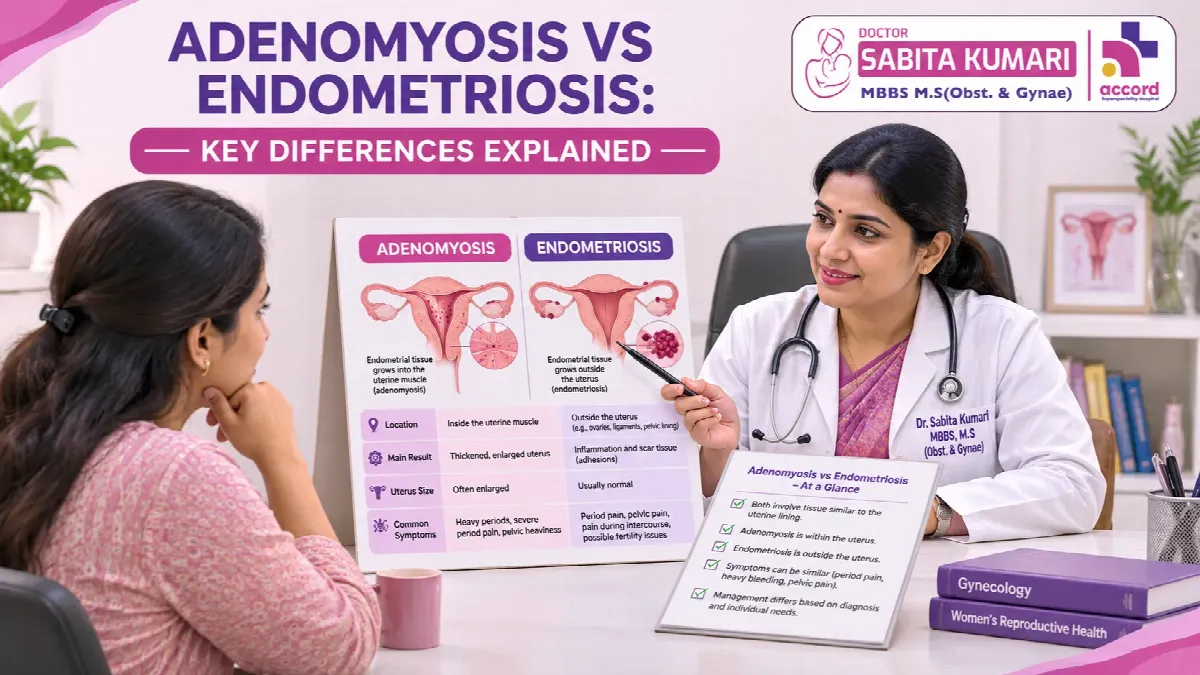
Both conditions involve tissue similar to the endometrium, the lining that builds up inside the uterus each month and sheds as a period. The difference is where that tissue ends up.
- In adenomyosis, the lining tissue grows into the muscle wall of the uterus (the myometrium). The problem stays inside the uterus.
- In endometriosis, lining-like tissue grows outside the uterus, most often on the ovaries, fallopian tubes, the ligaments behind the uterus, the bladder or the bowel.
A simple way to remember it: adenomyosis is "in the wall", endometriosis is "outside the walls". In both cases the misplaced tissue responds to monthly hormones, swells and bleeds, which causes inflammation and pain. Many women have both at the same time.
What Is Adenomyosis?
In adenomyosis, glands and supporting tissue from the uterine lining sit within the muscle layer of the uterus. Every month this tissue thickens and bleeds inside the muscle, which has no way to let the blood out. Over time the muscle thickens, the uterus becomes enlarged, soft and tender, and contractions during periods become stronger and more painful.
Adenomyosis can be diffuse, spread across much of the uterine wall, or focal, concentrated in one area. A focal patch that forms a lump is called an adenomyoma and is easily mistaken for a fibroid on a scan.
For a long time adenomyosis was thought to affect mainly women in their 40s who had given birth, because it was usually diagnosed only after a hysterectomy. Better ultrasound and MRI have shown that it is common in younger women too, often together with endometriosis and fibroids. Risk appears higher after previous uterine surgery such as caesarean section or curettage. Read more on our dedicated adenomyosis page.
What Is Endometriosis?
In endometriosis, tissue similar to the uterine lining grows on organs outside the uterus. The World Health Organization estimates that it affects around 10 percent of women of reproductive age, roughly 190 million women worldwide. The tissue bleeds and inflames the surrounding area each month, leading to scar tissue (adhesions) that can stick organs together.
Endometriosis takes several forms:
- Superficial endometriosis, small patches on the lining of the pelvis (peritoneum)
- Ovarian endometriomas, cysts on the ovary filled with old blood, often called "chocolate cysts"
- Deep endometriosis, which grows into the bladder, bowel or the tissue between the vagina and rectum
Endometriosis can begin with the first periods and often goes undiagnosed for years because period pain is wrongly treated as normal. Our article on when period pain may be endometriosis explains the warning signs.
Key Differences at a Glance
| Feature | Adenomyosis | Endometriosis |
|---|---|---|
| Where the tissue grows | Inside the muscle wall of the uterus | Outside the uterus: ovaries, tubes, pelvic lining, bladder, bowel |
| Size of the uterus | Often enlarged, bulky and tender | Usually normal size |
| Main bleeding pattern | Heavy, prolonged periods are very common | Periods may be normal or heavy; spotting before periods is common |
| Main pain pattern | Severe cramps during periods, heaviness in the uterus | Period pain plus pelvic pain at other times, pain with intercourse, bowel or bladder pain |
| Typical age at diagnosis | More often 30s and 40s, but seen in younger women | Often teens to 30s |
| Best test to detect it | Transvaginal ultrasound and MRI | Ultrasound and MRI for cysts and deep disease; laparoscopy for small patches |
| Effect on fertility | Can reduce implantation and raise miscarriage risk | Can block tubes, damage ovaries and cause adhesions |
| Permanent cure | Hysterectomy removes the disease | No single cure; surgery removes visible disease but it can return |
Symptoms Compared
The symptoms overlap so much that neither condition can be diagnosed from symptoms alone. Still, some patterns point more strongly towards one or the other.
Symptoms more typical of adenomyosis
- Heavy menstrual bleeding, often with clots, that leads to tiredness and anemia
- Very painful periods that have become steadily worse with age
- A feeling of heaviness, bloating or pressure in the lower abdomen
- An enlarged uterus that the doctor can feel on examination
- Pain that is centred in the middle of the lower abdomen, in the uterus itself
If heavy bleeding is your main problem, our guide to heavy periods and their causes explains how adenomyosis compares with other causes.
Symptoms more typical of endometriosis
- Period pain that starts a day or two before bleeding and can last after it ends
- Pelvic pain between periods, sometimes on one side
- Deep pain during or after intercourse
- Pain while passing stools or urine, especially during periods
- Bloating, nausea or bowel changes around the time of periods
- Difficulty getting pregnant, sometimes as the only sign
Symptoms both can cause
Severe period cramps, chronic pelvic pain, pain during intercourse, fatigue and reduced fertility appear in both. Some women with either condition have no symptoms at all and only discover it during a fertility check-up or a scan done for another reason.
Can You Have Both?
Yes, and it is common. Studies of women with endometriosis frequently find adenomyosis on imaging as well, and the reverse is also true. Both conditions are driven by estrogen and involve lining tissue in the wrong place, so they share risk factors. Fibroids also often appear alongside them. When a woman has both, symptoms tend to be more severe and fertility can be more affected, which is why a thorough assessment matters before any treatment plan is made. If fibroids are part of the picture, read our article on uterine fibroid symptoms and laparoscopic surgery.
How Doctors Tell Them Apart
Diagnosis begins with a detailed history of your periods, pain pattern, bowel and bladder symptoms and pregnancy plans, followed by a gentle pelvic examination. An enlarged, tender uterus suggests adenomyosis. Tenderness or nodules behind the uterus, or a fixed uterus that does not move freely, suggests endometriosis.
Transvaginal ultrasound
A good transvaginal scan is the first test for both. For adenomyosis, the sonologist looks for a thickened, uneven uterine wall, small cysts within the muscle, and a blurred boundary between lining and muscle. For endometriosis, the scan can detect ovarian endometriomas, and an experienced operator can spot deep endometriosis involving the bowel or bladder and check whether the ovaries are stuck to surrounding tissue.
MRI
MRI gives a clearer map of the uterine wall and is very useful when the scan is unclear, when adenomyosis and fibroids need to be told apart, or when deep endometriosis is suspected before surgery.
Laparoscopy
Small patches of superficial endometriosis do not show on scans. Laparoscopy, a keyhole procedure in which a camera is passed through a small cut near the navel, lets the surgeon see and treat endometriosis directly and take a sample for confirmation. Today, treatment is often started based on symptoms and imaging, and laparoscopy is reserved for women who need surgery anyway, have unclear findings, or are trying to conceive. Learn more about gynaec endoscopy, which covers both laparoscopy and hysteroscopy.
Blood tests
There is no blood test that confirms either condition. A blood count checks for anemia from heavy bleeding. CA-125 can be raised in both but is not reliable enough for diagnosis on its own. AMH helps assess ovarian reserve in women with endometriomas who want to conceive.
Effect on Fertility and Pregnancy
Many women with adenomyosis or endometriosis conceive naturally, so a diagnosis is not a verdict of infertility. The two conditions do, however, affect fertility in different ways.
- Endometriosis can distort the anatomy of the pelvis. Adhesions can block or twist the fallopian tubes, endometriomas can reduce the number of healthy eggs, and the inflammatory environment in the pelvis can affect egg quality and fertilization.
- Adenomyosis mainly affects the uterus itself. A thickened, irritable uterine wall can make it harder for an embryo to implant and has been linked with a higher risk of miscarriage and some pregnancy complications.
Women trying to conceive benefit from an early, tailored plan. This may include timed intercourse, ovulation induction, laparoscopic surgery for endometriosis, or referral for IUI or IVF, sometimes after a short course of medicines to calm adenomyosis. Read about our infertility evaluation and treatment and recurrent pregnancy loss care. Pregnancies in women with these conditions may also need closer monitoring through high-risk pregnancy care.
Treatment: Where They Overlap and Where They Differ
Treatment depends on your main symptoms, your age, the extent of disease and whether you want to become pregnant. Neither condition has a one-size-fits-all solution.
Pain relief
Anti-inflammatory painkillers taken from the day before a period is due can reduce cramps in both conditions. Heat, regular exercise and adequate sleep help some women, though they rarely control moderate or severe pain on their own.
Hormonal treatment
Both conditions depend on estrogen, so hormonal medicines that reduce or stop periods help both.
- Progestins, such as dienogest tablets, are widely used for endometriosis and also help adenomyosis pain.
- The hormone-releasing intrauterine device (LNG-IUS) works particularly well for adenomyosis because it acts directly on the uterus and reduces both bleeding and pain.
- Combined hormonal pills, taken cyclically or continuously, can lighten periods and reduce pain.
- GnRH medicines create a temporary low-estrogen state that shrinks disease and stops periods. They are usually used for a limited time, often before surgery or IVF.
Hormonal treatments control symptoms while they are being taken. They prevent pregnancy, so they are not suitable while trying to conceive, and symptoms can return once they are stopped.
Surgery for endometriosis
Laparoscopic surgery removes or destroys endometriosis patches, removes endometrioma cysts while protecting healthy ovarian tissue, and frees adhesions. It can relieve pain and improve natural fertility in selected women. Because endometriosis can involve the bowel or bladder, complex cases need careful planning. Ovarian surgery must be done conservatively, as repeated cyst removal can reduce egg reserve. See our page on ovarian cysts and our guide on when ovarian cyst surgery is needed.
Surgery for adenomyosis
Because adenomyosis lies within the uterine muscle, it cannot be peeled off the way endometriosis patches can. Options include:
- Excision of an adenomyoma, a uterus-preserving operation for focal disease in women who wish to conceive. It is technically demanding and suits selected cases only.
- Uterine artery embolization, which reduces blood flow to the affected area and can ease bleeding and pain in women who do not plan pregnancy.
- Hysterectomy, which removes the uterus and with it the adenomyosis. It is the only permanent cure and is considered for women who have completed their family and whose symptoms have not responded to other treatment. It can usually be done laparoscopically, and the ovaries can often be kept. Read our guide to laparoscopic hysterectomy and recovery.
Note that hysterectomy alone may not cure endometriosis outside the uterus, which is another reason an accurate diagnosis of which condition, or both, is present matters before surgery.
Living With Either Condition
Both conditions are long-term, and good care means more than a single prescription. These steps help many women stay in control:
- Keep a symptom diary of pain days, bleeding, bowel and bladder symptoms and how they relate to your cycle.
- Get your hemoglobin checked if periods are heavy, and treat anemia early.
- Do not accept disabling period pain as normal, and do not rely on painkillers alone for years without a diagnosis.
- Plan pregnancy timing with your gynecologist, since symptoms and fertility can change with age.
- Seek support for the emotional strain of chronic pain. It is a real part of these conditions and deserves attention.
When to See a Gynecologist
Book an appointment if you have any of the following:
- Period pain that makes you miss school, college or work, or that is getting worse each year
- Heavy or prolonged periods, clots or signs of anemia
- Pain during intercourse, or pain with bowel movements or urination during periods
- Pelvic pain between periods
- Difficulty conceiving after 12 months of trying, or 6 months if you are over 35
- An ultrasound report that mentions a bulky uterus, adenomyosis, endometrioma or chocolate cyst
Teenage girls with severe period pain deserve assessment too, since endometriosis can start early. See our page on adolescent health issues.
Gynecology Services by Dr. Sabita Kumari in Faridabad
Dr. Sabita Kumari, MBBS, MS (Obstetrics and Gynaecology), has about 16 years of experience and trained in minimally invasive surgery at AIIMS, New Delhi. She consults and operates at Accord Superspeciality Hospital, Sector 86, Faridabad. Care for adenomyosis and endometriosis sits within a full range of women's health services:
- Adenomyosis diagnosis, medical management and surgery
- Gynaec endoscopy: laparoscopy for endometriosis and cysts, hysteroscopy and laparoscopic hysterectomy
- Menstrual problems such as heavy, painful or irregular periods
- Fibroid uterus treatment, including laparoscopic and hysteroscopic myomectomy
- Ovarian cysts, including endometriomas
- PCOD and PCOS management
- Infertility evaluation and treatment
- High-risk pregnancy care and routine antenatal care
- Recurrent pregnancy loss evaluation
- Ectopic pregnancy treatment
- Amenorrhea (absent periods) evaluation
- Adolescent health issues for teenage girls
If you are looking for a specialist for this condition, our page on adenomyosis treatment in Faridabad explains how to book an assessment.
Book a Consultation
Adenomyosis and endometriosis are both treatable, and the right plan starts with knowing which one, or whether both, are causing your symptoms. Call or WhatsApp +91 9310600209 to confirm clinic timings, or use the form on our Contact page. Bring your previous ultrasound or MRI reports and a note of your period and pain pattern.
This article is for general information and does not replace a medical consultation. Please see a doctor for advice about your own health.