A positive pregnancy test is usually the start of good news. In about 1 to 2 out of every 100 pregnancies, though, the fertilized egg settles in the wrong place, most often inside a fallopian tube. This is an ectopic pregnancy. It cannot grow into a healthy baby, and if it is missed, the growing tissue can burst the tube and cause dangerous internal bleeding.
The good news is that an ectopic pregnancy found early can usually be treated safely, often without major surgery and with the best chance of protecting future fertility. That makes recognizing ectopic pregnancy symptoms in the first weeks one of the most useful things any woman who is pregnant, or trying to conceive, can know. This guide from the team of Dr. Sabita Kumari, an obstetrician, gynecologist and laparoscopic surgeon in Faridabad, explains the early warning signs, the emergency signs, who is at higher risk and how doctors diagnose and treat the condition.
What Is an Ectopic Pregnancy?
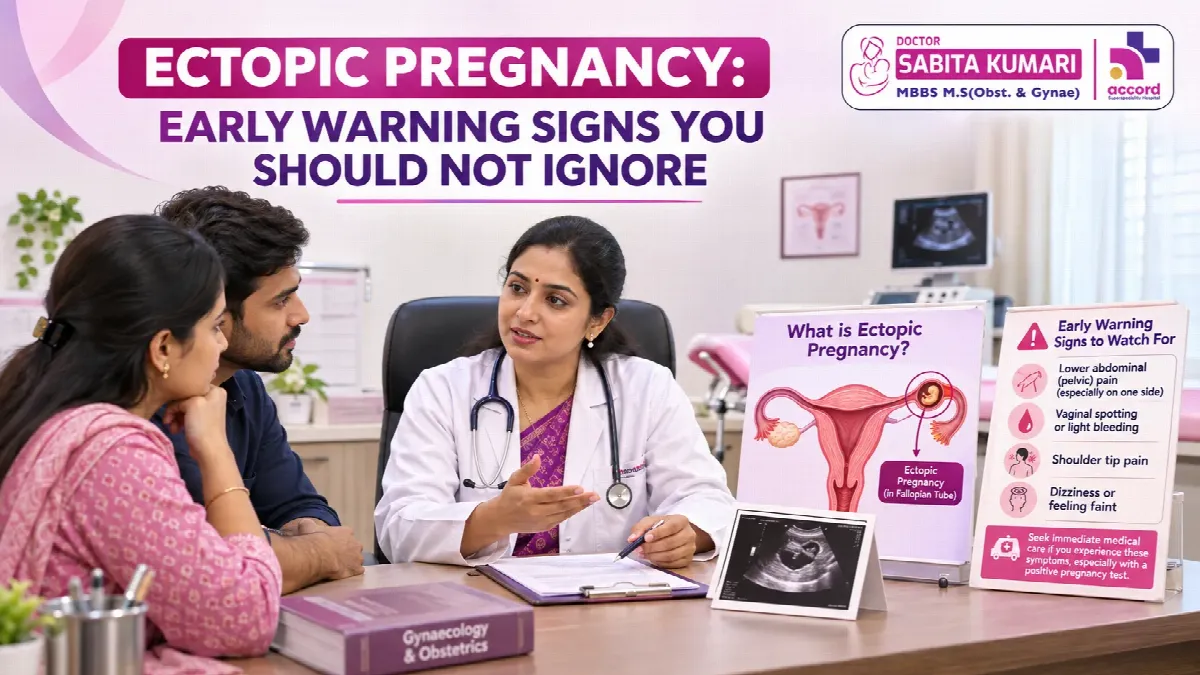
In a normal pregnancy, the egg is fertilized inside the fallopian tube and then travels down into the uterus over a few days, where it implants into the lining. In an ectopic pregnancy, the fertilized egg implants and starts growing somewhere outside the uterine cavity.
- More than 90 percent of ectopic pregnancies develop in a fallopian tube, which is why the condition is often called a tubal pregnancy.
- A small number occur on the ovary, in the cervix, in the part of the tube that runs through the uterine wall (interstitial or cornual pregnancy), in the abdomen, or in the scar of a previous caesarean section.
The fallopian tube is narrow and cannot stretch like the uterus. As the pregnancy grows, usually between the 5th and 10th week, the tube can tear. A ruptured ectopic pregnancy is a medical emergency. For a detailed overview of the condition and its treatment, see our page on ectopic pregnancy.
Early Ectopic Pregnancy Symptoms
In the first few weeks, an ectopic pregnancy often feels exactly like a normal pregnancy. The pregnancy test is positive, periods stop, and there may be breast tenderness, tiredness and nausea. Some women have no warning signs at all until the pregnancy is found on a scan. When symptoms do appear, they usually begin between 4 and 8 weeks after the last period.
Abnormal vaginal bleeding or spotting
Light bleeding or brown spotting is one of the most common early signs. It may be lighter or darker than a normal period, start and stop, or be mistaken for a late or unusual period. Bleeding in early pregnancy has many causes, including normal implantation and miscarriage, but it should always be checked when the location of the pregnancy is not yet confirmed.
Pain on one side of the lower abdomen
Pain is the other classic warning sign. It is often felt on one side of the lower abdomen or pelvis, though it can be on both sides or in the middle. It may start as a dull ache or cramp and come and go, then become sharper or more constant. Pain that keeps getting worse over hours or days needs prompt assessment.
Shoulder tip pain
Pain at the tip of the shoulder, where the shoulder ends and the arm begins, is an unusual but important symptom. It happens when blood leaking inside the abdomen irritates the diaphragm and the nerve that shares a pathway with the shoulder. It may be worse when lying down. Shoulder tip pain together with a positive pregnancy test should be treated as an emergency.
Pressure in the rectum or discomfort with bowel movements
Blood collecting low in the pelvis can create a feeling of pressure in the back passage, an urge to open the bowels, or pain while passing stools. Some women also have diarrhea or discomfort while passing urine. These signs are easily confused with a stomach upset, which is one reason ectopic pregnancy is sometimes missed.
Feeling faint, dizzy or unusually weak
Dizziness, light-headedness or a feeling of weakness can be a sign of internal blood loss. Combined with pain or bleeding in early pregnancy, it should never be ignored.
Emergency Signs of a Ruptured Ectopic Pregnancy
Go to the nearest hospital emergency department immediately, or call an ambulance, if you are pregnant or could be pregnant and have any of the following:
- Sudden, severe or sharp pain in the abdomen or pelvis
- Pain at the tip of the shoulder
- Fainting, collapse, or feeling as if you are about to faint
- Rapid heartbeat, pale and clammy skin, or confusion
- Heavy vaginal bleeding
Do not wait to see if the pain settles, and do not drive yourself. A ruptured ectopic pregnancy can cause severe internal bleeding within a short time, and quick surgery is lifesaving. Internal bleeding is not always matched by heavy vaginal bleeding, so the absence of visible bleeding is not reassuring.
How Ectopic Pregnancy Symptoms Differ From a Normal Pregnancy or Miscarriage
Many early pregnancy problems share the same signs, which is why tests rather than symptoms decide the diagnosis.
- Normal early pregnancy can cause mild cramps and occasional light spotting, but pain is usually mild, central and not getting worse.
- Miscarriage usually causes cramping, central pain and bleeding that becomes heavier, often with clots or tissue.
- Ectopic pregnancy more often causes one-sided pain, light or dark spotting rather than heavy bleeding, and sometimes shoulder tip pain, bowel pressure or dizziness.
Other conditions, such as a twisted or bleeding ovarian cyst, appendicitis or a urinary infection, can also cause one-sided pelvic pain. If you have a positive pregnancy test and pain or bleeding before a scan has confirmed that the pregnancy is inside the uterus, contact your gynecologist the same day. Women with a history of pregnancy loss may also find our guide on recurrent miscarriage causes, tests and treatment helpful.
Who Is at Higher Risk?
Ectopic pregnancy can happen to any sexually active woman, and about half of women diagnosed have no known risk factor. The risk is higher with:
- A previous ectopic pregnancy
- Past pelvic infection (pelvic inflammatory disease), including infections such as chlamydia or gonorrhea
- Previous surgery on the fallopian tubes, including tubal ligation (sterilization) or its reversal
- Other pelvic or abdominal surgery, including caesarean section
- Endometriosis, which can scar and distort the tubes. Our article on adenomyosis vs endometriosis explains how endometriosis affects the pelvis.
- Infertility and fertility treatment, including IVF
- Becoming pregnant with an intrauterine device (IUD) in place. IUDs prevent most pregnancies, but if a pregnancy does occur with one, it is more likely to be ectopic.
- Smoking, and increasing age, especially over 35
If any of these apply, tell your doctor as soon as your pregnancy test is positive. An early scan at around 6 weeks can confirm where the pregnancy is growing. Planning ahead also helps; see our preconception checklist for steps to take before trying to conceive.
How Ectopic Pregnancy Is Diagnosed
Because the symptoms are not specific, diagnosis relies on a combination of examination, ultrasound and blood tests. Your doctor will ask about the date of your last period, your symptoms and any risk factors, check your pulse and blood pressure, and gently examine the abdomen and pelvis.
Transvaginal ultrasound
A scan through the vagina is the most important test. It shows whether there is a pregnancy sac inside the uterus and can often detect a pregnancy or a mass next to the ovary or in the tube. It can also show free fluid or blood in the pelvis, which suggests bleeding. Very early in pregnancy, the pregnancy may be too small to see anywhere, which doctors call a "pregnancy of unknown location".
Beta hCG blood tests
Beta hCG is the pregnancy hormone. In a healthy early pregnancy inside the uterus, the level usually rises by a predictable amount over 48 hours. A level that rises too slowly, plateaus or falls irregularly raises concern for an ectopic pregnancy or a failing pregnancy. Doctors often repeat the test two days apart and compare it with the scan findings. Above a certain hCG level, a pregnancy inside the uterus should be visible on ultrasound, and its absence strongly suggests an ectopic pregnancy.
Other tests
A blood count checks for blood loss, blood group is checked so that women with a Rh negative group can receive anti-D protection, and liver and kidney tests are done if medical treatment is being considered. In unclear cases with significant pain, diagnostic laparoscopy allows the surgeon to look directly at the tubes and treat the problem in the same procedure.
Treatment Options
There is no way to move an ectopic pregnancy into the uterus. Treatment aims to remove the pregnancy safely while protecting your health and future fertility. The choice depends on your symptoms, the hCG level, the size and position of the pregnancy, whether it has ruptured, and your wishes for future pregnancy.
Expectant management
Some very early ectopic pregnancies are already failing and resolve on their own. If you have no pain, are stable, and hCG levels are low and falling, your doctor may recommend close monitoring with repeat blood tests until the hormone returns to zero. You must be able to return to hospital immediately if symptoms change.
Medical treatment with methotrexate
An injection of methotrexate stops the pregnancy cells from growing, and the body then absorbs the tissue over the following weeks. It suits women who are stable, have no signs of rupture, have a small ectopic pregnancy without a heartbeat and have a relatively low hCG level. Blood tests are repeated over several weeks to confirm that hCG falls to zero, and a second dose is sometimes needed. During this time, heavy lifting, intercourse, alcohol and folic acid supplements are usually avoided, and pregnancy is postponed for at least three months.
Laparoscopic surgery
Surgery is needed when the tube has ruptured or is at risk of rupture, when hCG levels are high, when there is a heartbeat in the ectopic pregnancy, or when medical treatment is unsuitable or has failed. In most stable women, it is done laparoscopically through small cuts using gynaec endoscopy, which means less pain and a faster recovery than open surgery.
- Salpingectomy removes the affected tube along with the pregnancy. It is usually preferred when the other tube looks healthy.
- Salpingostomy removes the pregnancy through a small opening and keeps the tube. It may be chosen when the other tube is damaged or absent, but follow-up hCG tests are needed because a small amount of pregnancy tissue can remain.
In an emergency with heavy internal bleeding, open surgery may be the fastest and safest option. Most women go home within one or two days after laparoscopic surgery and return to normal activities within two weeks.
Recovery and Emotional Wellbeing
Physical recovery is often quicker than emotional recovery. An ectopic pregnancy is a pregnancy loss, and feelings of grief, shock, guilt or anxiety about future pregnancies are common and valid. Talking to your partner, family, doctor or a counselor can help. Nothing you did, such as exercise, work or intercourse, caused the pregnancy to implant in the wrong place.
Women with Rh negative blood who have surgery usually receive an anti-D injection. Your doctor will also advise when it is safe to try again, often after one or two normal periods following surgery and at least three months after methotrexate.
Pregnancy After an Ectopic Pregnancy
Most women who have had an ectopic pregnancy go on to have a healthy pregnancy later, even with only one working tube. The chance of another ectopic pregnancy is higher than average, so in your next pregnancy:
- Contact your gynecologist as soon as your pregnancy test is positive.
- Have an early transvaginal scan, usually at around 6 weeks, to confirm the pregnancy is inside the uterus.
- Report any pain or bleeding straight away rather than waiting for the scheduled scan.
If pregnancy does not happen naturally, an infertility evaluation can check the remaining tube and other factors, and IVF can bypass the tubes completely when needed. Once a pregnancy is confirmed in the uterus, women with a previous ectopic may benefit from closer monitoring through high-risk pregnancy care. Our guide on choosing a pregnancy doctor in Faridabad may also help you plan your antenatal care.
Gynecology Services by Dr. Sabita Kumari in Faridabad
Dr. Sabita Kumari, MBBS, MS (Obstetrics and Gynaecology), has about 16 years of experience and trained in minimally invasive surgery at AIIMS, New Delhi. She consults and operates at Accord Superspeciality Hospital, Sector 86, Faridabad, where emergency gynecological care is available. Her services include:
- Ectopic pregnancy diagnosis, medical treatment and laparoscopic surgery
- Gynaec endoscopy: laparoscopy and hysteroscopy for tubal, ovarian and uterine problems
- High-risk pregnancy care and routine antenatal care
- Recurrent pregnancy loss evaluation and treatment
- Infertility evaluation and treatment
- Ovarian cysts, including laparoscopic cyst removal
- Fibroid uterus treatment
- Adenomyosis diagnosis and treatment
- Menstrual problems such as heavy, painful or irregular periods
- PCOD and PCOS management
- Amenorrhea (absent periods) evaluation
- Adolescent health issues for teenage girls
If you are looking for a specialist, our page on ectopic pregnancy treatment in Faridabad explains how to book an urgent assessment.
Book a Consultation
If you have a positive pregnancy test with pain, spotting or any of the ectopic pregnancy symptoms described here, do not wait for your routine scan. Call or WhatsApp +91 9310600209 for an early assessment, or use the form on our Contact page. If you have severe pain, shoulder tip pain or feel faint, go to the nearest emergency department straight away.
This article is for general information and does not replace a medical consultation. Please see a doctor for advice about your own health.