Many parents in India think a gynecologist is only for married women, pregnancy or serious problems. As a result, teenage girls often live with painful periods, very heavy bleeding, acne and excess hair, or worries about their changing bodies without ever getting proper advice. Problems that are simple to manage at 14 or 15 are sometimes found only years later.
A visit to an adolescent gynecologist is not about illness. It is a chance for a girl to understand her body, ask questions in a safe space and catch common problems early. This guide explains when a teenage girl should first see a gynecologist, the signs that mean she should go sooner, what actually happens at the first visit, and how parents can make it comfortable. It is written by the team of Dr. Sabita Kumari, an obstetrician and gynecologist in Faridabad.
The Right Age for the First Gynecologist Visit
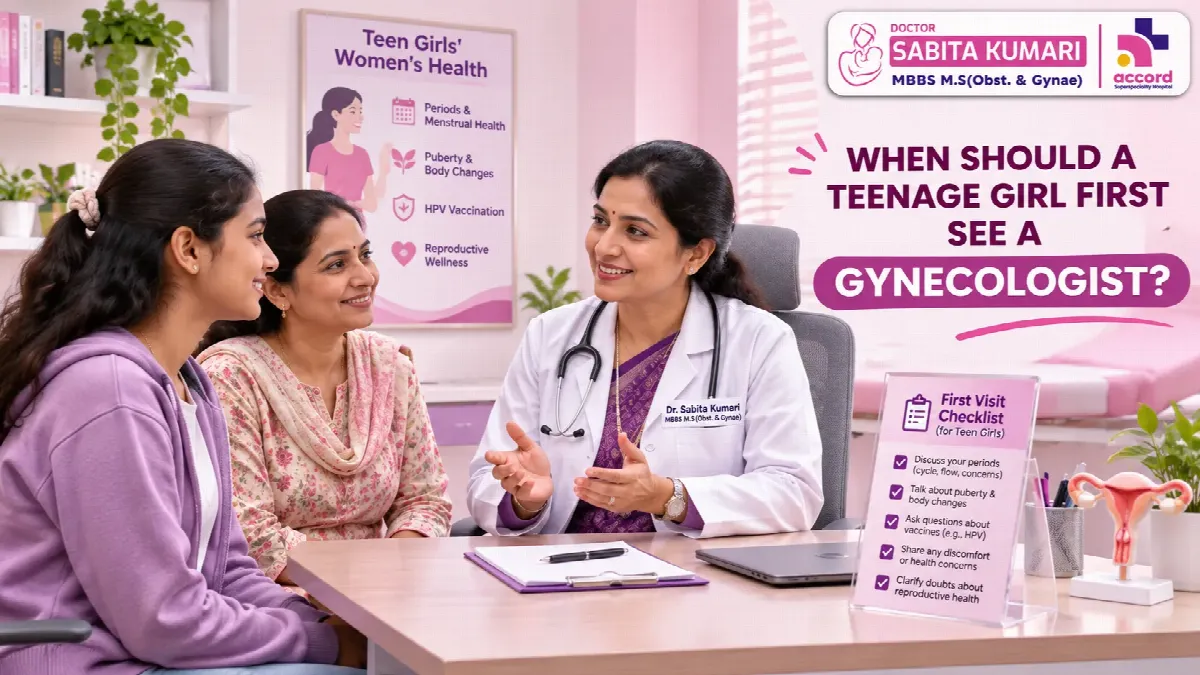
Leading gynecology bodies, including the American College of Obstetricians and Gynecologists, recommend that girls have their first visit with a gynecologist between the ages of 13 and 15. In India this is still uncommon, but the reasoning applies to every girl: this is the age when periods have usually started, questions about the body are increasing, and habits that last a lifetime are forming.
This first visit is usually just a conversation. In most cases no internal examination is needed. The aim is to build trust, give accurate information and check that growth and periods are developing normally, so that the girl knows where to turn if a problem comes up later.
A girl does not have to wait until 13 if she has symptoms. And if she is older and has never been, it is never too late to start.
Signs a Teenage Girl Should See a Gynecologist Sooner
Book an appointment without waiting for a routine visit if any of the following apply.
Problems with puberty timing
- No signs of breast development by age 13
- No period by age 15, or within three years of breast development
- Signs of puberty, such as breast growth or periods, before age 8
Delayed or absent periods can be due to hormonal problems, low body weight, excessive exercise, thyroid disease or, rarely, differences in how the reproductive organs formed. Early assessment matters. Learn more on our page on amenorrhea (absent periods).
Period problems
- Periods that are very heavy, soaking a pad every hour or two, or lasting more than seven days
- Periods that come more often than every 21 days, or more than 45 days apart after the first two years
- Periods that suddenly stop after being regular
- Pain so severe that it causes vomiting, fainting or missing school every month, and does not improve with ordinary painkillers
- Signs of anemia such as constant tiredness, breathlessness or pale skin
Irregular cycles are common in the first year or two after periods begin, but persistent problems deserve attention. Our guides on irregular periods and when to see a gynecologist and when period pain may be endometriosis explain these in more detail.
Hormonal signs
- Acne that does not respond to usual treatment
- Excess hair on the face, chest or abdomen
- Rapid weight gain, especially around the waist, or dark patches on the neck
Together with irregular periods, these can point to PCOS or PCOD, which often starts in the teenage years. Early lifestyle changes and treatment make a big difference. See our page on PCOD and PCOS.
Other concerns
- Abnormal vaginal discharge with itching, a bad smell or a change in colour
- Lower abdominal pain that is severe or keeps coming back, which can sometimes be due to an ovarian cyst
- Breast lumps, pain or discharge from the nipple
- Questions about the body, puberty, hygiene or relationships that she feels unable to discuss elsewhere
When to go to the hospital immediately
Seek emergency care for sudden severe abdominal pain, very heavy bleeding with dizziness or fainting, or high fever with pelvic pain.
What Happens at the First Visit
Many girls avoid the gynecologist because they imagine an uncomfortable examination. In reality, the first visit for a teenager is mostly a friendly conversation.
The conversation
The doctor will ask about general health, growth, when periods started, how often they come, how heavy and painful they are, and any symptoms she has noticed. Questions about diet, sleep, exercise, school stress and mood are also common, because all of these affect periods and hormones. There are no wrong answers, and the girl is encouraged to ask her own questions.
General check-up
Height, weight, body mass index and blood pressure are usually recorded. The doctor may look at the skin for acne or excess hair and check the thyroid gland in the neck.
Examination only if needed
An internal pelvic examination is usually not done at a first visit for a teenager, unless there is a specific problem that needs it. If an examination of the outer genital area or breasts is needed, the doctor will explain why and what it involves, ask for consent and have a female attendant or parent present. The girl can ask to stop at any time.
Tests if required
Depending on symptoms, the doctor may suggest:
- Blood tests such as hemoglobin, thyroid function, blood sugar or hormone levels
- An abdominal ultrasound, which is painless and done over the tummy, to look at the uterus and ovaries
- Urine tests if there are urinary symptoms
Confidentiality and Building Trust
For teenagers, being able to speak freely is essential. A good adolescent gynecologist will usually spend part of the consultation with the parent present and part with the girl alone. This gives her the chance to ask questions she may feel shy about in front of family.
Doctors respect a teenager's privacy while also keeping her safe. If there is any risk to her health or safety, the doctor will discuss the best way to involve parents or guardians. Explaining this at the start helps both the girl and her parents feel comfortable.
Topics an Adolescent Gynecologist Can Help With
- Understanding puberty and periods: what is normal and what is not
- Menstrual hygiene: choosing and changing pads, cups or other products, and caring for the genital area
- Period pain management: safe use of painkillers, heat, exercise and when to seek further treatment
- Heavy bleeding and anemia: testing, iron supplements and treatment options
- PCOS and weight: diet, exercise and medical treatment
- Acne and hair growth: identifying hormonal causes
- Nutrition: iron, calcium, vitamin D and healthy eating for growth
- Emotional health: mood changes around periods, stress and body image
- Vaccination: including the HPV vaccine
- Accurate information: about the body, relationships and staying safe, in an age-appropriate way
Our adolescent health services cover all of these concerns in a supportive, confidential setting.
The HPV Vaccine: An Important Step for Teenage Girls
The human papillomavirus (HPV) vaccine protects against the types of HPV that cause most cases of cervical cancer, one of the most common cancers among women in India. The vaccine works best when given before any exposure to the virus, which is why it is recommended for girls from 9 to 14 years of age, usually as two doses. Older girls and young women can also be vaccinated, though they may need three doses.
A visit to the gynecologist is a good time to discuss the HPV vaccine, the right schedule and any concerns about side effects, which are usually mild, such as a sore arm.
Common Gynecological Problems in Teenage Girls
Irregular periods
In the first one to two years after periods begin, cycles are often irregular because ovulation is not yet regular. Persistent irregularity after this time, or long gaps between periods, should be checked for PCOS, thyroid problems or other hormonal causes.
Painful periods (dysmenorrhea)
Mild cramps are normal. Pain that stops a girl from going to school or doing normal activities is not something she must simply tolerate. It can usually be treated effectively, and severe or worsening pain may need evaluation for endometriosis.
Heavy periods
Heavy bleeding in teenagers can be due to hormonal immaturity, but in some girls it is the first sign of a bleeding disorder. Heavy periods from the very first cycle, frequent nosebleeds or easy bruising should be checked.
PCOS
Irregular periods, acne, excess hair and weight gain can be signs of PCOS. Diagnosis in teenagers needs care, because some of these features are normal in early puberty. Early guidance on lifestyle reduces long-term risks such as diabetes.
Vaginal discharge and infections
Clear or white discharge is normal and often starts before the first period. Itching, redness, a bad smell or coloured discharge may need treatment.
Ovarian cysts
Small functional cysts are common and usually disappear on their own. Sudden severe pain, which can occur if a cyst twists the ovary, needs urgent assessment.
Myths That Stop Girls From Seeing an Adolescent Gynecologist
- Myth: Only married women need a gynecologist. Gynecologists care for women and girls at every stage of life, from puberty to menopause.
- Myth: A gynecologist visit always means an internal examination. For most teenagers, the visit is a conversation and a general check-up. An internal examination is done only if there is a clear medical reason, with consent.
- Myth: Painful periods are normal and must be tolerated. Pain that disrupts school or daily life can be treated and sometimes signals a condition that needs care.
- Myth: Irregular periods will settle after marriage. Persistent irregular periods often have a cause, such as PCOS or thyroid problems, that should be found and managed now.
- Myth: Talking about periods is embarrassing. Periods are a normal part of health. Open conversations help girls recognise problems early and seek help without shame.
Healthy Habits That Support Teenage Gynecological Health
- Eat regular, balanced meals with iron-rich foods such as green leafy vegetables, dals, jaggery and eggs, along with calcium from milk and curd.
- Get at least 60 minutes of physical activity most days, through sports, dance, cycling or brisk walking.
- Maintain a healthy weight; both very low and high weight can disturb periods.
- Sleep seven to nine hours a night and limit late-night screen time.
- Drink enough water and limit sugary drinks, junk food and excess caffeine.
- Talk to a trusted adult or doctor if stress, mood changes or body image worries become overwhelming.
Tips for Parents
- Talk about periods and body changes early, before they start, in a calm and positive way.
- Present the gynecologist visit as a normal health check, like visiting a dentist, not as a sign that something is wrong.
- Let your daughter choose whether she wants you in the room for all or part of the consultation.
- Help her keep a simple period diary with start dates, duration, heaviness and pain.
- Do not ignore complaints of severe pain, heavy bleeding or missed periods as "normal for girls".
- Encourage a balanced diet, regular physical activity and enough sleep.
Tips for Teenage Girls
- Write down your questions before the visit so you do not forget them.
- Note when your last period started and how your periods usually are.
- Be honest with the doctor. Everything you share is to help you, not to judge you.
- Ask the doctor to explain anything you do not understand.
- Remember that you can always ask to speak to the doctor alone.
Gynecology Services by Dr. Sabita Kumari in Faridabad
Dr. Sabita Kumari, MBBS, MS (Obstetrics and Gynaecology), has about 16 years of experience and trained in minimally invasive surgery at AIIMS, New Delhi. She consults at Accord Superspeciality Hospital, Sector 86, Faridabad, and offers gentle, confidential care for teenage girls alongside a full range of women's health services:
- Adolescent health care: puberty concerns, period problems and HPV vaccination counseling
- Menstrual problems such as heavy, painful or irregular periods
- PCOD and PCOS management
- Amenorrhea (absent periods) evaluation
- White discharge and vaginal infection treatment
- Ovarian cyst, fibroid and adenomyosis treatment
- Gynaec endoscopy: laparoscopy and hysteroscopy
- Infertility evaluation and treatment
- High-risk pregnancy care and routine antenatal care
- Ectopic pregnancy and recurrent pregnancy loss care
- Menopause care and routine gynecological check-ups
Book a Consultation
A first visit to a gynecologist in the teenage years can set your daughter up for a lifetime of good health and confidence about her body. Call or WhatsApp +91 9310600209 to book a consultation, or use the form on our Contact page.
This article is for general information and does not replace a medical consultation. Please see a doctor for advice about your own health.