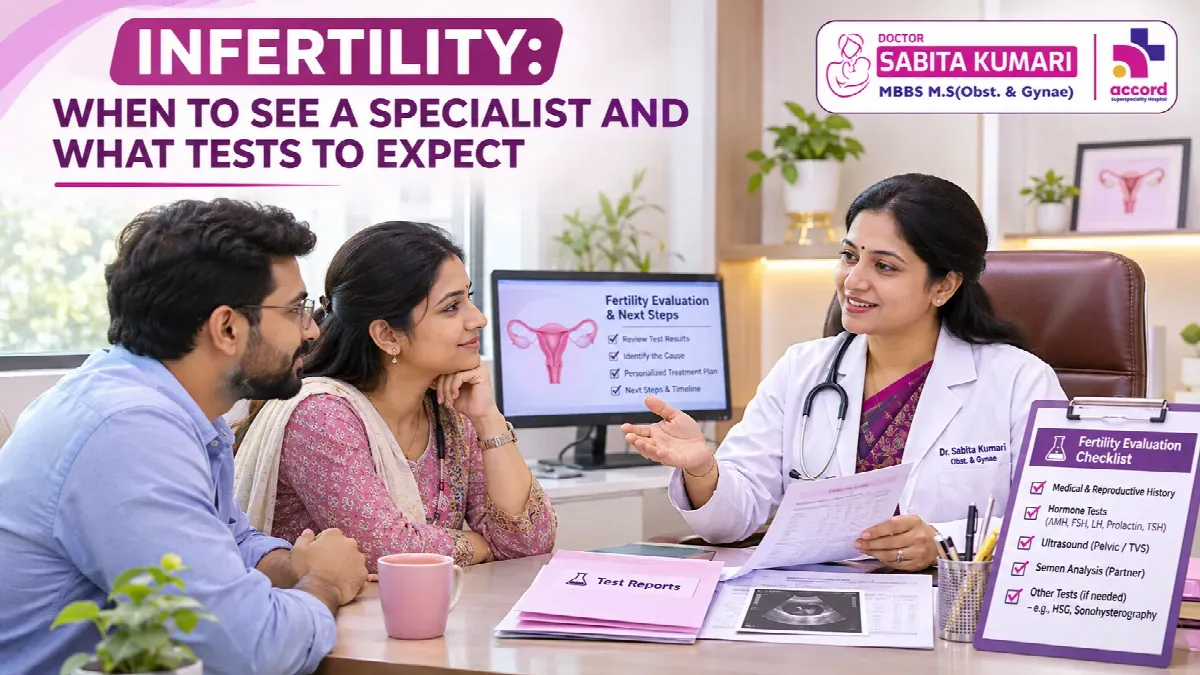
Trying for a baby month after month without success can be one of the most stressful experiences a couple goes through, made harder by advice from family, endless online searches and uncertainty about when to seek help. Infertility is far more common than most people think. The World Health Organization estimates that around one in six people of reproductive age experience infertility at some point in their lives.
The encouraging news is that most causes can be identified with a set of simple, step-by-step infertility tests, and many couples conceive after targeted treatment. This guide explains when to see a fertility specialist, what tests to expect for both partners, what the results mean and how the information guides treatment. It is written by the team of Dr. Sabita Kumari, an obstetrician and gynecologist in Faridabad who evaluates and treats couples trying to conceive.
What Is Infertility?
Doctors define infertility as not getting pregnant after 12 months of regular unprotected intercourse. For women aged 35 or older, an evaluation is advised after 6 months because fertility declines more quickly with age.
There are two broad types. Primary infertility means a couple has never conceived. Secondary infertility means difficulty conceiving after a previous pregnancy, even if that pregnancy was successful. Secondary infertility is common and deserves the same evaluation.
It is important to remember that infertility is a problem of the couple, not just the woman. In roughly a third of couples the main cause is found in the woman, in about a third in the man, and in the rest both partners contribute or no clear cause is found. This is why both partners should be tested from the start.
When to See an Infertility Specialist
Book a consultation if you are:
- Under 35 and have been trying for 12 months without success
- 35 to 40 and have been trying for 6 months
- Over 40, in which case it is wise to seek advice before you start trying or soon after
Reasons to seek help earlier
Do not wait the full year if any of the following apply:
- Irregular periods, very long cycles or no periods at all
- Known PCOS or PCOD, thyroid problems or diabetes
- Very painful periods, pain during intercourse or known endometriosis
- Previous pelvic infection, appendix rupture or abdominal surgery
- A previous ectopic pregnancy or two or more miscarriages
- Fibroids, ovarian cysts or a past cyst operation
- Previous cancer treatment with chemotherapy or radiation
- In the male partner: a history of testicular injury, surgery, undescended testes, mumps after puberty or sexual difficulties
Our infertility page explains the evaluation and treatment options available for couples in Faridabad.
The First Consultation
The first visit is mostly a detailed conversation with both partners. The doctor will ask about:
- How long you have been trying and how often you have intercourse
- Menstrual history: age at first period, cycle length, flow and pain
- Previous pregnancies, miscarriages, abortions or ectopic pregnancies
- Medical conditions, surgeries, infections and medicines
- Lifestyle factors such as weight, diet, smoking, alcohol, work stress, sleep and exercise
- Family history of early menopause, genetic conditions or birth defects
A general examination, including weight, blood pressure and signs of hormonal problems, is followed by a pelvic examination and usually an ultrasound. Bring all previous reports, scans and prescriptions to this visit.
Infertility Tests for Women
Female fertility tests answer three main questions: Is ovulation happening? Are the fallopian tubes open? Is the uterus healthy? They also check egg reserve and general health.
Tests for ovulation and hormones
- Day 2 to 3 hormone tests: FSH, LH and estradiol give information about ovarian function.
- AMH (anti-Mullerian hormone): a blood test that reflects the number of eggs remaining, known as ovarian reserve. It can be done on any day of the cycle. AMH helps plan treatment but cannot predict natural fertility on its own.
- Mid-luteal progesterone: checked about a week before the expected period to confirm that ovulation has happened.
- Thyroid function (TSH) and prolactin: imbalances in these hormones can stop or disturb ovulation.
- Testosterone and other tests if PCOS is suspected.
- Follicle monitoring (follicular study): a series of transvaginal scans across the cycle to watch an egg follicle grow and release.
PCOS is one of the most common reasons for ovulation problems. Our article on PCOD and fertility explains how it is managed.
Pelvic ultrasound
A transvaginal ultrasound, ideally early in the cycle, checks the uterus and ovaries. It can detect fibroids, polyps, adenomyosis, ovarian cysts, endometriomas and the antral follicle count, which is another measure of egg reserve. It is quick, painless and one of the most useful infertility tests.
Tests for the fallopian tubes
- HSG (hysterosalpingography): an X-ray test in which a dye is passed through the cervix to see whether it flows freely through the uterus and tubes. It is done a few days after the period ends and before ovulation. Some women feel cramping for a short time.
- Sono-HSG or HyCoSy: a similar test done with ultrasound instead of X-ray.
- Diagnostic laparoscopy: a keyhole procedure under anesthesia in which the surgeon looks directly at the tubes, ovaries and pelvis, checks tubal patency with dye and can treat endometriosis, adhesions or cysts at the same time. It is used when other tests suggest a problem or when there is pelvic pain.
Tests for the uterine cavity
- Saline infusion sonography: an ultrasound with saline inside the uterus to outline the cavity.
- Hysteroscopy: a thin telescope passed through the cervix to look inside the uterus. It can diagnose and treat polyps, fibroids inside the cavity, scar tissue and a uterine septum in the same sitting.
Laparoscopy and hysteroscopy are part of gynaec endoscopy, which allows many problems affecting fertility to be treated through tiny incisions with a quick recovery.
General health tests
Hemoglobin, blood group, blood sugar, vitamin D, rubella immunity and screening for HIV, hepatitis B and C and syphilis are usually done to make sure you are healthy for pregnancy.
Infertility Tests for Men
Male testing is simple, non-invasive and should be done early, before any invasive tests on the female partner.
Semen analysis
This is the most important male fertility test. A semen sample is collected after 2 to 5 days of abstinence and examined within an hour. The lab checks:
- Volume of semen
- Sperm count or concentration
- Motility, the percentage of sperm moving well
- Morphology, the percentage with normal shape
- Signs of infection or other abnormalities
Results are compared with WHO reference values. Because sperm counts can vary from sample to sample, an abnormal result is usually repeated after a few weeks before drawing conclusions.
Further male tests if needed
- Hormone tests such as FSH, LH, testosterone and prolactin
- Scrotal ultrasound to look for varicocele or other problems
- Sperm DNA fragmentation test in selected cases
- Genetic tests if the sperm count is very low or absent
- Referral to a urologist or andrologist when needed
Understanding Your Results
Once the tests are complete, your doctor will put the results together to find the likely causes. The common categories are:
- Ovulation problems, often due to PCOS, thyroid or prolactin imbalance, weight issues or low ovarian reserve
- Tubal factor, from blocked or damaged tubes after infection, surgery or endometriosis
- Uterine factor, such as fibroids, polyps, adhesions or adenomyosis
- Endometriosis, which can affect the tubes, ovaries and egg quality
- Male factor, involving sperm count, movement or shape
- Unexplained infertility, when all standard tests are normal, which occurs in a significant number of couples
An unexplained diagnosis can feel frustrating, but it does not mean nothing can be done. Many couples with unexplained infertility conceive with simple treatments.
Treatment Options After Testing
Treatment is tailored to the cause, the woman's age, ovarian reserve and how long the couple has been trying.
- Lifestyle changes: reaching a healthy weight, stopping smoking and alcohol, managing stress and timing intercourse around ovulation can significantly improve chances.
- Ovulation induction: tablets or injections to help the ovaries release an egg, with follicle monitoring to time intercourse.
- Treating underlying conditions: correcting thyroid or prolactin imbalance, managing PCOS and controlling blood sugar.
- Surgery: hysteroscopic removal of polyps, fibroids or septum, and laparoscopic treatment of endometriosis, cysts, adhesions or blocked tubes.
- IUI (intrauterine insemination): washed sperm are placed directly into the uterus around ovulation. It is often used for mild male factor, cervical factor or unexplained infertility.
- IVF and ICSI: eggs are fertilized in the lab and embryos are transferred to the uterus. This is advised for blocked tubes, severe male factor, low ovarian reserve or when other treatments have not worked.
Your doctor will explain the success rates and costs of each option for your situation, so you can make an informed decision.
How Age Affects Fertility
A woman is born with all the eggs she will ever have, and both the number and quality of eggs decline with age. Fertility starts to fall gradually from the early 30s and more quickly after 35, while the risk of miscarriage and chromosomal problems rises. This is why the waiting period before testing is shorter for women over 35, and why women over 40 are encouraged to seek advice early. Male fertility also declines with age, though more slowly. If you plan to delay pregnancy, an AMH test and a discussion with your gynecologist can help you understand your options.
Common Myths About Infertility
- Myth: Infertility is always the woman's problem. Male factors contribute in a large share of couples, so both partners should be tested.
- Myth: Regular periods mean fertility is normal. Women with regular cycles can still have blocked tubes, endometriosis or low egg reserve.
- Myth: Stress alone causes infertility. Stress can affect cycles and wellbeing, but most infertility has a physical cause that can be found with tests.
- Myth: IVF is the only solution. Many couples conceive with simpler treatments such as ovulation induction, surgery or IUI.
- Myth: Having had a child means you cannot have fertility problems. Secondary infertility is common and deserves the same evaluation.
Preparing for Your Infertility Tests
- Track your periods for at least two to three months, noting start dates and cycle length.
- Bring all previous reports, scans, operation notes and prescriptions.
- Note that some tests are timed to your cycle. Day 2 to 3 hormone tests and HSG need to be scheduled around your period.
- For semen analysis, the male partner should avoid ejaculation for 2 to 5 days before the test, but not longer.
- Write down your questions in advance.
- Attend together whenever possible. Infertility is a shared journey, and both partners' input matters.
Lifestyle Steps That Support Fertility
- Aim for a healthy body weight. Both underweight and overweight can affect ovulation and sperm quality.
- Eat a balanced diet rich in vegetables, fruits, whole grains, pulses and protein.
- Start folic acid at least one month before trying to conceive. Our preconception checklist covers other steps.
- Stop smoking and limit alcohol for both partners.
- Avoid excess heat for men, such as hot baths, saunas and laptops on the lap.
- Get regular exercise and enough sleep, and find ways to manage stress.
- Have intercourse every two to three days through the cycle, which covers the fertile window without the pressure of exact timing.
Taking Care of Your Emotional Health
Infertility affects more than the body. Feelings of sadness, frustration, guilt and isolation are common, and pressure from family or society can make them worse. Open communication between partners, realistic expectations and support from a counselor or support group can make the journey easier. A good fertility team will also take your emotional wellbeing into account.
Gynecology Services by Dr. Sabita Kumari in Faridabad
Dr. Sabita Kumari, MBBS, MS (Obstetrics and Gynaecology), has about 16 years of experience and trained in minimally invasive surgery at AIIMS, New Delhi. She consults at Accord Superspeciality Hospital, Sector 86, Faridabad, and offers a full range of women's health services:
- Infertility evaluation for couples, follicle monitoring, ovulation induction and IUI guidance
- Gynaec endoscopy: diagnostic and operative laparoscopy and hysteroscopy
- PCOD and PCOS management
- Fibroid uterus, adenomyosis and ovarian cyst treatment
- Menstrual problems and amenorrhea evaluation
- Recurrent pregnancy loss evaluation
- Ectopic pregnancy treatment
- High-risk pregnancy care and routine antenatal care
- Adolescent health issues for teenage girls
- Menopause care and routine gynecological check-ups
Book a Consultation
If you have been trying to conceive without success, the right tests at the right time can save months of uncertainty. Call or WhatsApp +91 9310600209 to book a fertility consultation for you and your partner, or use the form on our Contact page.
This article is for general information and does not replace a medical consultation. Please see a doctor for advice about your own health.